Friday, July 21, 2017

17 Tips for Winter Moving:

Winter is here! And you have to move your household right in the middle of it. For at least 39 of the U.S. States, winter means freezing temps and snow. We rounded up 17 tips from experienced movers to help your winter move go smoothly:

1. Confirm details with your movers.

Waiting to move in the winter is pretty smart. Winter is moving companies’ off-seasons, so you should have a wider range of dates available to choose from. Just be sure to check in with your movers a week before the move and a day or two before the move. Because in winter, we all know the weather can be unpredictable.

2. Keep checking the weather.

Speaking of weather, keep a sharp eye on it. Check it every week leading up to the move, and then every day the week of the move. If you’re concerned the weather will shut down roads or hinder your movers, call the moving company and express your concern. It’s better to delay the move than get caught in a blizzard.
tips-moving-winter-blizzard
Photo by Don Gunn/Flickr

3. Cover your floors.

Make sure your house stays clean and your carpet and hardwood are protected while people are tromping in and out. Grab a couple cheap plastic tarps from the nearest hardware store, and lay floor mats down at every outside door.

4. Turn the heat off.

Think about it: if you have people going in and out all day, your poor furnace will be trying to heat the house and it will all go straight out the door. If you turn the heat off, just for the day, not only will you save on that electric bill, but you’ll then be able to do tip 5 (and make your movers’ day!).

5. Heat your bathroom.

If the heat in the house is off, run a space heater in the main floor bathroom, and keep that door closed. Nothing’s better than being treated to a few minutes of warmth while you take care of business.

6. Board your pets.

No one wants a puppy underfoot while they’re trying to move, and if you take our advice and turn the heat off, your puppy will need to stay somewhere warm. Check local boarders and kennels for heated runs, heated floors, and one or two day discounted rates. Make sure the fur babies are taken care of before the day of the move.

7. Clear the sidewalks, driveways, and street.

It doesn’t get more dangerous than carrying a heavy couch down an icy sidewalk. Be sure to salt, shovel, or snow blow any major walkways you think the movers will be using so they can walk safely with your belongings. And so you avoid a lawsuit.
tips-moving-winter-sidewalks
Photo by Alex/Flickr

8. Check the utilities at the new house.

Nothing — we repeat NOTHING – is worse than having no heat and no light in the dead of winter. Make sure that all of the utilities at your new home are turned on and actually working before you start moving. We recommend getting everything turned on about two days before your move.

9. Check the snowplow schedule.

You’ve carefully planned every detail of your move, the movers arrived bright and early, and last night’s plow guy left a really nice bank of mushy, dirty snow between the moving truck and your house. Make sure you have parking available that’s not on the plow route or leave yourself enough time to forge a path to the house.

10. Have sheets, towels, and blankets on hand.

Halfway through moving your furniture out to the truck, the skies open up and the snow is just pelting down. And if you don’t have sheets or blankets near the front door, the movers will have to carry Grandmother’s antique writing desk through the downpour with no protection.

11. Warm up your insides.

Keep a crockpot of hot chocolate or hot apple cider heating in the kitchen – for you and the movers. When you can’t feel your fingers anymore, or the poor movers are looking a bit frostbitten, call a halt for a cup of hot cocoa. You’ll feel better, and your movers will think you’re awesome.
tips-moving-winter-cider
Photo by NatalieMaynor/Flickr

12. Spare a pair of gloves.

Gloves are vital in winter conditions, but if you’re a mover, your gloves may get soaked through quickly or be inadequate against the cold. Grab a couple extra pairs of warm gloves on your next dollar store trip and offer them as an extra layer or replacement when the snow picks up.

13. Double pack fragile items.

Many things that are delicate or extra fragile become more brittle in cold weather. Help your movers out by double packing your fragile items so they’re less likely to break while moving. Also remember: any items that can be damaged by cold should not be packed in the truck. The truck may sit out overnight, which could cause more damage than you hoped for.

14. Baby your electronics.

Electronic devices really do not like cold weather. Pack all electronics into one or two boxes, and make sure those travel in your car, where the heat will be on and they can maintain a steady temperature.

15. Keep winter essentials with you.

It’s tempting to make room in your car for a pillow and sleeping bag, but make sure your extra clothing layers, coats, snow boots, hats, gloves, scarves, and a handful of cozy quilts also make it into the car. Can you imagine if they got loaded on the truck instead?! Brrrrr!

16. Be flexible and err on the side of caution.

While it’s already really frustrating and stressful to move in the winter, winter weather only adds to the number of possible complications. Your movers can’t control the weather, and are probably colder than you are. So listen to their concerns – if the roads are icy, it’s safer to delay the move a little than risk your possessions and people’s lives.
tips-moving-winter-truck
Photo by Flickr User/Flickr

17. Tip well.

Moving companies’ rates don’t change much in the winter, so your movers probably aren’t getting paid extra to deal with snow, ice, and wind. Thank them for coming out in the winter and make sure they each get a good tip to reinforce your appreciation.
Moving in the winter months doesn’t have to be as hard as it sounds. With a little forethought and consideration, you can make it an ideal move despite the weather. Good luck!

Saturday, June 24, 2017

People Are Still Leaving the Bay Area—But The Places They’re Moving to Have Changed:

Last year, Redfin discovered that about one in four people who were searching on Redfin from the San Francisco Bay Area were looking for homes in other parts of the country. That was up from about one in seven in 2011, having increased consistently over the four years. As of this spring, the portion of Bay Area buyers looking to move has leveled off, but what’s changed is where they’re looking to go. Most notably, Seattle has become a less popular destination, while “other” cities, which include Washington, D.C., Austin, Denver, and Boston at the top of the list, have become more common havens for those leaving the Bay Area.
Bay Area Diaspora
This outward migration is almost certainly due to the growing cost of housing in the Bay Area. As of May this year, the median home sale price in the San Francisco metro area was $1.2 million. The neighboring metros, San Jose and Oakland, are also among the most expensive housing markets in the country at $930,000 and $650,000 as of last month.

The Digital Diaspora

This makes other similar West Coast metros such as Seattle and Portland increasingly attractive, given that their average homes cost half what they would in the Bay Area. But the percentage of Bay Area-based searches for homes in Seattle fell by 45 percent to just 2.8 percent from 5.1 percent last Spring.
Seattle Redfin agent Daniel Burton notes that while searches may be down, he is still working with many buyers from the Bay Area who now live in Seattle.
“It’s quite common for people to begin home searches a year or so before they buy to test the waters and get settled financially, and in their new jobs and cities,” said Burton. “We’re working quite a bit with this second wave of Bay Area homebuyers—people who searched for Seattle homes while still in the Bay Area and decided to rent for a year or two after moving, and are now entering the market to buy.”
Seattle has been adding a lot of tech jobs the last couple years, giving rise to a large tech migration. However, there have been mixed feelings about the city’s growth.
This influx of new jobs has brought many benefits to Seattle’s economy. Yet, over the same period Seattle has grown more unequal, with the portion of families’ incomes at the high and low ends increasing and those in the middle-income range decreasing.
New homes are being built in Seattle to accommodate some of this growth, but the majority are higher-end homes at expensive price points. This has been a trend for years now. In 2010, the average new construction condo cost 50 percent more than the average existing ones. In 2015, new condos cost more than twice as much as existing condos.
Sale Price Distribution of Condos in Seattle in 2015
While fewer people are looking in Seattle this year than last, the proportion of people searching within the Bay Area remained relatively stable. So where did these searches go? Mostly to other growing and still affordable tech hubs like D.C., Austin, Denver and Boston.

The Other Silicon Valleys

Tech jobs are very fluid as software companies can move employees from, say, San Francisco to Austin, much more easily than a manufacturing plant or retail warehouse would be able to relocate their operations. This also allows tech workers to adapt quickly to where the jobs are located.
Although jobs in technology total only 3.9 million (less than 3 percent of all U.S. workers), they can have large impacts on their cities. The growth of tech jobs in Seattle has brought population changes that outpaced the supply of housing. Many of these migrants to Seattle are young, educated and very well paid–shifting the demand for housing. This, in turn, pushed up housing prices for the whole area.
Zoning regulations holding back the supply of housing growth, however, may be more to blame than the new wealth from tech growth. This is why some new tech hubs are not destined for the same fate as Silicon Valley. A growing and vibrant economy is a great thing, so long as the supply of new housing units meets this influx of workers.
Median Home Prices
While tech jobs continue to grow in Seattle and Silicon Valley, at 4 percent and 10 percent respectively, they have been rapidly growing in Austin, Boston, D.C. and Denver as well. According to the latest data from the Bureau of Labor Statistics, Austin increased tech sector employment by roughly 9,000 jobs from 2014 to 2015, a 17.6 percent annual growth rate. At the same time the cost for urban living has increased, pushing home sales 1.6 miles (12.3%) farther from the city center since 2011.
“Builders can’t keep up with the demand closer to the central core of Austin, but areas like Pflugerville, Cedar Park and Round Rock are experiencing rapid growth and new-build communities are getting snatched up quickly by buyers moving to the area from more expensive cities like San Francisco,” said Lauren Johnson, Redfin agent in Austin.
“Living 30 minutes outside of the urban core doesn’t faze many of my clients—for a third of the price they’re getting three times the property, so being just outside the city is a fair trade. One of my recent clients was living in a $1 million townhome in San Jose, and purchased a much larger home in Pflugerville for under $400,000.”
Boston‘s tech growth hasn’t played out in the same way as the other cities, though. An influx of tech workers has only offset a longtime outward migration of locals seeking warmer climates, keeping house price appreciation lower than in the other cities.
“With their high incomes and large down payments, tech workers pack a big punch,” said Redfin chief economist Nela Richardson. “Even small numbers of workers moving from the Bay Area can have dramatic effects on high-demand neighborhoods in the urban core near jobs and city amenities. Locals often can’t compete and end up moving farther away from urban tech hubs where they can afford to live.”
Washington, D.C.’s tech sector doesn’t look simply like another Silicon Valley. Instead, D.C.’s tech scene is taking a top down approach and allowing closer ties for tech-companies to the federal government, with a heavy role in defense contracting and other public related spending. The District is using tax breaks and grants for high-tech companies, trying to make it the largest tech hub on the East Coast.
Denver’s tech scene increased 10.7 percent, bringing in 5,603 tech jobs. That growth has accounted for 20 percent of all new jobs produced in the city. The Mile High City’s tech startups are noted to foster growth among one another. Denver’s growth has also been heavier among millennials and more concerned with social good and civic hacking. 
Cluster Incentives
High-skilled tech workers benefit greatly from proximity to one another. Software companies can more easily share talent and ideas. A startup scene in one city will attract other software developers to join in and collaborate.
The job growth in these cities is not limited to tech, though. Berkeley Economist Enrico Moretti found that for every new high-tech job in a city, five additional jobs are created outside tech in that city over the subsequent decades.
This growth in tech won’t be slowing anytime soon. The Bureau of Labor Statistics projects that tech jobs will grow at about 12 percent per year, double the average of all occupations. These new tech hubs must get ahead of this growth with a particular focus on housing if they want to avoid repeating the Valley’s mistakes.
_________
Check out these past articles in this series from our CEO, Glenn Kelman: The Digital Diaspora, When Technologist Come to Town, & Second Silicon Valleys.

Wednesday, May 31, 2017

8 Steps to Moving Out for the First Time:

Moving Out


Moving out for the first time is an emotional rollercoaster that twists ruthlessly between joy and horror, massive excitement and deep anxiety. It’s all good when you’re thinking of having no one around to tell you what to do, but then thoughts like ‘Where do I buy light bulbs’ and ‘Do these look like termites to you?’ start to sneak in. Indeed, moving out of your parents’ house is a major life change, with lots of steps and details to consider- this guide is designed to alleviate the stress and dissolve the mystery of the First Ever Move.


  1. Get your finances in order

    While you’ve been living at home, you probably had at least some kind of financial safety net. Now that you’re heading out on your own you need to have a better understanding of what a budget is and how it works. Consider your monthly income, and find out what your average monthly expenses are. Start by listing the non-negotiable payments like your car, groceries, phone bill, and so on. From there you can break down what you’ll need and how much you can afford and want to spend on rent. Plan your budget for moving out- the cost of a moving company or a rental moving truck and purchases you will need to make for your first apartment. Since you’ll likely need to pay a deposit as well as your first month’s rent, tuck away some extra cash in the months leading up to your move. Take a look at this blog post for some great advice on saving up for your first move.

  1. Nail down a steady job

    Congratulations, you’re an adult! It’s no picnic, and no place will teach you this faster than the workplace. Most young adults who first head out into the world start their climb to the top in some sort of entry level position. In most industries, such positions are not famous for fat paychecks- do not let this discourage you! Instead, use this job as an opportunity to showcase your talent and ambition and plan wisely for future success. Keep in mind- if your entry level job doesn’t cover the rent, maybe it’s not the time to flee the nest just yet.

  1. Find a suitable place to live

    This stage might take some time but it will definitely pay off if you don’t rush it. There are lots of places to look for a good apartment online, and the best place to start is your social media profiles. Get the word out that you’re looking for a great rental and see what comes up. You can also go through listings on Craigslist, Apartments.com, ForRent, or Rent Jungle, to name but a few. Also, consider this:
       
    • To Roommate or Not to Roommate
      Moving in with someone is (almost always) the more frugal choice. On an emotional level, it can relieve some of the anxiety of moving out for the first time, especially if that person is someone you already know. One great option is to team up with a friend, look for a home, furnish it and move into it together. Another option is to move in with somebody who’s looking to share their apartment- that could be even more economical as it is likely their place will be mostly furnished. If you can afford to rent without roommates (or if you’re a bit of a misanthrope), you will probably want your first place all to yourself. It might be smaller and less accommodating, but it’ll be all yours.

    • Location
      Another major decision similar to the roommate dilemma is the question of location. How do you decide where to rent your first apartment? There are many things to take into consideration. First of all, it needs to be close enough to your workplace, as well as other places of interest depending on your likes, wants and needs. For example, you might want to live near a gym, a park or a really good bakery. Second, it needs to be safe. If the rent seems too low, check the crime rate on that street before signing the lease. Lastly, it needs to be accessible and have good public transportation. It will make your social life livelier and might even mean you could ditch your car (and car payments).

    In any case, plan ahead and start collecting things you’ll need for your new abodes like furniture, kitchen items, and personal essentials unless you’re planning on moving cross-country. In that case, it’s smarter to buy those things once you’ve moved. Check out this first apartment moving checklist to know what you should start stocking up on.

  1. Hire a professional moving company

    This is one step that many unfortunately miss: a professional moving company will take the hassle and backache out of moving. You have enough to worry about with the rest of the small details, so let a team of full service movers do the work and make your first moving experience a good one. Getting a quote from Unpakt will help you factor this expense into your moving budget well in advance, too — so you can stay on top of your finances and make sure you get a good deal on moving coverage to protect your belongings.

  1. Create a schedule of chores

    In those first few months of living out on your own, it can be tempting to let everything get a little loose- a sink overflowing with dirty dishes, laundry that never gets folded, a bathroom that just gathers soap scum… you get the picture. Trust us- after a while, you’ll wish you haven’t let things get so bad. Instead of succumbing to your inner teenager, try to create (and stick to) a schedule of chores immediately upon moving in. If you have a housemate, get them on board so you can both contribute to keeping your house a home.


  1. Practice good habits before you move out

    If you’ve been living the easy life without having to do many chores or watch your budget, start changing those habits now to make the transition easier down the road. Pay close attention to your cleanliness habits and step them up a notch. Start sticking to a budget now so you can get an accurate picture of your spending habits before relocating. Perhaps the most difficult: set yourself up with a daily routine to prepare yourself for entering the work world. Yes, that means an alarm clock. Sorry.

  1. Don’t be afraid to ask your parents for help

    They’ve likely done this before, at least a few times, so they’ll be able to help you understand what to expect. Ask them to help you lay out anticipated moving expenses, including the little things you might not think of like a shower curtain, a plunger, or a fresh coat of paint in your new kitchen. Plus, they’re probably going to miss having you around — so giving them the opportunity to take care of you while they can just make them feel good.

  1. Get the party started!!!

    Nothing says “I have arrived” like throwing your first house party. House parties can be as casual or as outlandish as suits your nature, but the basic necessities include guests, music, snacks and beverages. Start by choosing a date and drawing up the list of people you’d like to invite. You can then begin to plan the refreshments table- if you’re feeling overwhelmed at this point you can ask a few close friends to help you organize.

Whether you’re moving locally or across the country, that first leap out of your parents’ home is an exciting one. Good luck!

Tuesday, May 16, 2017

Moving Safety: Keeping Things In Control For Your Movers And Family;:

Moving safety: Keeping things in control for your movers and family

A safe move is a happy move. Making sure your belongings are packed up safely and that everyone in your family has the items they need during the move are crucial considerations. How can you make your move safe and successful? Check out this advice:

Keep some things close by

"How can you make your move safe and successful?"
Whether you're making a cross-country move or traveling to your new home across town, there are some things you'll want and need to keep close by. One important consideration is medicine: If you or a family member needs to have easy access to a prescription in an emergency or has to regularly take doses of a given medicine throughout the day, you need to ensure quick access to it. In general, we recommend carrying any needed medicine inside the family car, as well as other valuables like personal documents, jewelry and personal electronics.
There are other, similar considerations to make, too. Do your kids have a favorite toy or prized possession they can't bear to be without? Don't let it get packed up and out of their reach. In the middle of a book you can't put down? Keep it close by so you can take a little time for yourself after a long day of moving.

Pack safely

Atlas's experienced, professional movers put any concerns about safely transporting your possessions to rest. When you have Atlas pack up your belongings before hitting the road, you can be sure your possessions are safe and secure from the get go. If you decide to pack up yourself, make sure to wrap fragile items in protective material, limit the overall weight of boxes to prevent breakage and refer to our list of non-allowable items to understand which things you need to transport yourself.

Plan ahead

The last problem you want to deal with on moving day is getting lost or turned around on the way to your new home. Make sure you have the right address information and that you share it with your movers. It's also a good idea to double-check directions ahead of time, especially for a long-distance move or one involving many twists and turns on the road. Writing down the directions is a good fail-safe plan, just in case your map app or GPS unit decides to stop working at the most inopportune time.
In the end, the best thing you can do to keep your move safe and in control is think things through before the big day. Plan ahead, and you can keep the entire process going forward smoothly.

Tuesday, April 4, 2017

Moving to the Bay Area:


The San Francisco Bay Area is considered far and wide to be one of the great epicenters of arts and culture in the country. Offering everything from historic landmarks to high-tech points of interest, there’s also plenty of natural beauty to be found in its various state parks and ruggedly beautiful coastal areas. Moving to the Bay Area, you’ll discover that there’s so much to see and do that there may not be time for it all.

Moving Advice

As one of the most auto-centric regions in the country, the Bay Area is known for its frequently colossal traffic jams and generally busy roads, even during downtime hours. This may make your initial arrival into town as a new resident something of a challenge. Here are a few tips to help you avert the inherent catches and snags of moving to the Bay Area.
Although you’ll rarely encounter a vacant freeway at any hour of the day or night, the most heavily congested times of day for road travel are the Monday through Friday rush hours of 6 to 9 a.m. and later from 3 to 7 p.m. Try to schedule your move in the early afternoon if you can.
Many freeways throughout the Bay Area have the left-hand lane dedicated to carpoolers during certain posted hours. Carpools are defined as more than one person in the vehicle, including a child in a car seat. Remember that just because you’ve got more than one person in your vehicle, you’re not required to be in the carpool lane. If you don’t plan on passing traffic, keep to the right.
It’s a good idea to get the lay of the land prior to your arrival to account for any especially steep inclines or narrow streets that could impact a moving van’s progress. If you’re moving to downtown San Francisco, for example, you’ll encounter plenty of hilly streets, so plan your move accordingly.
Determine if you need a moving permit. There’s no requirement for you to obtain a moving van permit when moving the Bay Area, but if you’ve ascertained that parking shortages in the immediate vicinity may cause you to have a tough time unloading a moving van, contact the police department or city offices to find out how to get a permit.
Map out student populations. The California state university system has dozens of campuses scattered throughout the San Francisco Bay area, in addition to many private colleges. This could impact your decision about precisely where to put down roots when moving to the Bay Area, especially if you’re not interested in living in a neighborhood with a heavy student population. Some of the cities with the largest student populations include San Francisco, Berkeley, San Jose and Santa Cruz.
Check the weather. The Bay Area has varying climates, depending on your proximity to the coast or how far inland you’re located. Often, temperature changes from one area to another can be significant. To ensure you’re adequately prepared for your move, check weather forecasts in advance here.
Earthquake activity in the San Francisco Bay Area is frequent, but the majority of tremors are so small they’re undetectable. Quakes of moderate size are relatively infrequent, which may come as something of a surprise to newcomers, especially considering that the Bay Area is the location of the infamous San Andreas Fault.
Don’t forget to fill out a change of address form with the United States Post Office before you move to ensure continuity of mail delivery. The best advice is to submit paperwork one week before your move, since processing can take as long as 7-10 business days.

Neighborhoods

The San Francisco Bay Area is a big place, measuring almost 7,000 square miles. It has a total of nine counties to its credit and six distinct sub-regions that are home to its 7.15 million residents. These six sub-regions are comprised of the following recognized areas.
  • San Francisco
  • The East Bay
  • The North Bay
  • The South Bay
  • The Peninsula
  • Santa Cruz/San Benito Counties

Getting Around

Moving to the Bay Area provides you with a bevy of alternatives to vehicle ownership. For those who live and work within San Francisco city limits, it’s entirely possible to rely solely on public transportation and to not own a vehicle. On the other hand, getting around throughout other sections of the Bay Area will likely require one of two things: a car or plenty of additional time, required to make use of the various public transportation options. The links below will provide you with information on all available public transportation programs in the San Francisco Bay Area.
If you’re moving to the Bay Area and are arriving by air, there are three main points of entry serving commercial airlines both domestically and internationally.
The Bay Area is served by an extensive system of highways and freeways that enable trans-bay travel and route traffic to and from all points on the map. The major freeways leading into the Bay Area include:
  • US Route 101
  • Interstate 80
  • Interstate 280
  • California State Route 1
  • California State Route 35
  • Interstate 880
  • Interstate 680
  • Interstate 580
  • State Route 152
  • State Route 156
  • State Route 29

Relocation Resources

If you’re relocating to the Bay Area to find a better way of life for yourself and your family, you’ve chosen the right place. Overall, the San Francisco Bay area is one of the most affluent areas in the nation, boasting two of the wealthiest counties in the United States: Marin County and Santa Clara County. In Marin County, average per capita income is $91,000. In Santa Clara County, the median household income is $93,000.
Although unemployment in California reflects numbers that are above the national average, jobs in the Bay Area remain plentiful for qualified personnel in a variety of industries. Encouraging numbers, like 2015’s reported Gross Domestic Product of $785 billion for the Bay Area (if compared against other countries, this would mean the Bay Area has the seventeenth highest GDP in the world), continue to illustrate that its job market remains healthy, despite far less desirable conditions throughout the rest of the country.

Media Outlets

Are you moving to the Bay Area? If so, one of the first things you’ll want to do is read up about local news and happenings, while keeping your eye on national and international news. Here’s a list of some of the San Francisco Bay Area’s top newspapers and local TV channels.
San Francisco Chronicle
Published seven days a week, the San Francisco Chronicle is one of California’s longest-running publications. Founded in January of 1865 when Abraham Lincoln was still in office, the Chronicle’s daily average circulation is around 225,000, with its Sunday edition fetching close to 290,000 readers. The Chronicle, which has earned top honors by winning six Pulitzer Prizes throughout its history, is full of local, state, national and international news.
Despite its slightly left-leaning political bend, it’s read far and wide and considered to be the premium news source among residents living in San Francisco, as well as the city’s numerous outlying areas. The newspaper’s sections include news, sports, business, entertainment, and a living section that often caters to the city’s LGBT population.
The San Francisco Examiner
Beating out The Chronicle in age by a full two years, The San Francisco Examiner has been churning out daily news since the Civil War was still raging. Throughout its history, the newspaper has hired a number of writers who later went on to become classic American authors, including Jack London, Mark Twain and Ambrose Bierce. In 1965, The Examiner and Chronicle joined forces. These days, The San Francisco Examiner is a free publication that runs six days per week and reaches approximately 200,000 readers with its mix of local news, sports coverage, business and job listings, and local entertainment features.
San Jose Mercury News
Starting out in 1851 as The San Jose Weekly Visitor, today’s San Jose Mercury News reaches an audience almost as wide as San Francisco’s Chronicle and Examiner combined. With close to 530,000 readers during the week and an impressive 602,000 for its Sunday edition, the Mercury is also no stranger to acclaim, having won two Pulitzer Prizes in the 1980s. Considered by most to be a left-leaning publication, it features a healthy mix of national and international news articles, sports, business and entertainment. Local news includes not only the city of San Jose, but also stretches north to neighboring San Francisco and as far south as Santa Cruz.
SF Weekly
The premiere free daily publication catering to San Francisco’s culturally diverse population, SF Weekly is an alternative news publication that focuses on local stories and local arts and entertainment. Its circulation is estimated at between 75,000 and 85,000.
Local TV News Channels
If you’re moving to the Bay Area you can tune into the following local TV stations for full news coverage:

Climate

Because of the diversity of geographical regions within the San Francisco Bay Area, it’s impossible to categorize its weather within any single definition. Temperature variations here can be drastic, sometimes as great as 40 degrees from the coast to inland areas in a single day.
  • Coastal areas offer the least amount of temperature variation year round, with winters that are mild and wet, and summers that are comparatively cooler than what you’ll find moving further inland. Living on the coast frequently brings fog during the summer months.
  • Inland areas that are separated from the Pacific breeze by mountains usually experience the greatest temperature swings, with hot, dry summers and winter nights that can drop to near freezing.
Because of the number of cars on the road at any given time, smog levels in the Bay Area can be heavy, although conditions are not nearly as bad as those you’ll find further down the coast near Los Angeles. The state-run AIRNow website publishes an Air Quality Index (AQI) that offers frequently updated information on air quality.

Schools

If you’re moving to the Bay Area with school-aged children, your first order of business should be to research the quality of learning institutions available. In the state of California, there’s an open enrollment policy that gives you the option of sending your child to any available school—including charter schools—as long as that school in the same district as your home. Below, you will find a listing of the top five elementary, junior and senior high schools in the Bay Area to help you make the wisest scholastic choices for your young.
Top 5 Elementary Schools
  1. William Faria Elementary (Cupertino)
  2. Nelson S. Dillworth Elementary (San Jose)
  3. Mission San Jose Elementary (Fremont)
  4. Millikin Elementary (Santa Clara)
  5. Herbert Hoover Elementary (Palo Alto)
Top 5 Junior High Schools
  1. American Indian Public Charter School II (Oakland)
  2. William Hopkins Junior High (Fremont)
  3. Redwood Middle (Saratoga)
  4. John F. Kennedy Middle (Cupertino)
  5. Ardis G. Egan Junior High (Los Altos)
Top 5 High Schools
  1. Dr. T.J. Owens Gilroy Early College Academy (Gilroy)
  2. Pacific Collegiate Charter (Santa Cruz)
  3. Lowell High (San Francisco)
  4. Monta Vista High (Cupertino)
  5. Palo Alto High (Palo Alto)
Top 5 School Districts
  1. Hillsborough School District
  2. Las Lomitas School District
  3. Los Altos School District
  4. Lakeside Joint School District
  5. Orinda School District

Government

For helpful information when moving to the Bay Area, visit the following government websites covering a broad range of services from car registration and licensing to tax law considerations.

Saturday, March 25, 2017

Mortgage Rates and Fed Announcements:


Mortgage Rates and Fed Announcements
File this one under “no need to panic,” despite constant warnings of a Fed move impacting mortgage rates.
You can’t blame them (the media) – it makes for a good headline, but much of what is thrown out there usually isn’t true or anything to worry about.
In most cases, it’s fear mongering, or simply something to fill the page. It tends to be a regurgitated article that comes out around the time the Fed meets, which is every six weeks throughout the year (eight times annually).
Whenever a Fed announcement comes along, you’ll start to see an uptick in articles about what mortgage rates will do when the Fed speaks, with the most common one being “rates expected to rise” or something of that nature.
Or you’ll get straight up definitive articles warning you about the impending rate rise and what you should/can do to mitigate the damage. The problem is it’s simply not accurate and these things tend to do more harm than good.

The Fed Doesn’t Announce Mortgage Rates

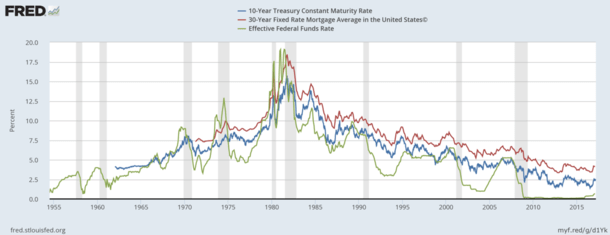
fed funds vs mortgage rates
When the Fed gets together to set the target rate for the Federal Funds Rate, financial markets (stocks, bonds, etc.) pay attention and react. As does the media because it’s generally a big deal. But Janet Yellen and co. don’t sit down and decide which way mortgage rates will go.
Rather, they discuss the state of the broader economy, inflation, monetary policy, and so on. They almost never mention mortgages explicitly, except for at the moment thanks to the remnants of the quantitative easing program known as QE3.
Additionally, there’s no clear correlation between the Federal Funds Rate and mortgages. In other words, one can go up while the other goes down. Or one can do nothing while the other does something. Or they can move in the same direction for a while.
But the spread between the two won’t remain in a certain range over time like mortgage rates and the 10-year bond yield do. You can’t say the 30-year fixed should be X% higher or lower than the Fed Funds Rate at any given time.
As you can see from the St. Louis Fed chart above, the 10-year yield and the 30-year fixed (based on Freddie Mac data) move in relative lockstep. You can see the blue line and red line move in a very similar fashion over the years with a pretty steady spread. Then there’s the green line (Fed Funds Rate), which is all over the place.